MC_100km_jra_iaf+wombatlite-test1-e1de2a94
✅ Latest submission: Run 65 completed successfully (2026-10-03 21:06 AEST). Model date reached: 2024-01-01 (66.0 model years complete).
Notebooks: ocean_stats, timeseries, Timeseries_daily_extreme_from_2D_fields, temp-salt-vs-depth-time
GitHub issue: ACCESS-NRI/access-om3-configs#1669
📋 Summary for the GitHub issue
### OM3 Monitor summary: `MC_100km_jra_iaf+wombatlite-test1-e1de2a94`


- **Latest submission:** ✅ Run 65 completed successfully (2026-10-03 21:06 AEST).
- **Model date reached:** 2024-01-01 (66.0 model years complete)
- **Average throughput:** 21.92 SYPD
- **Truncations:** 1,216 in 2 of 66 output folders

| Where | Records | Output folders | Max speed (m/s) | Max CFL |
|---|---:|---|---:|---:|
| [108.9°W, 72.9°N](https://www.google.com/maps/place/72.91,-108.87/@72.91,-108.87,5z) | 24 | 042 | 13.8 | 1.42 |
| [108.1°W, 72.4°N](https://www.google.com/maps/place/72.38,-108.12/@72.38,-108.12,5z) | 24 | 042 | 13.5 | 1.38 |
| [96.9°W, 75.9°N](https://www.google.com/maps/place/75.88,-96.86/@75.88,-96.86,5z) | 17 | 036, 042 | 15.9 | 1.81 |
| [62.4°W, 82.0°N](https://www.google.com/maps/place/82.01,-62.41/@82.01,-62.41,5z) | 10 | 042 | 6.6 | 0.70 |
| [97.1°W, 75.3°N](https://www.google.com/maps/place/75.31,-97.10/@75.31,-97.10,5z) | 9 | 036, 042 | 13.4 | 1.50 |

**References**
1. Archive folder: `/g/data/ol01/outputs/access-om3-100km/MC_100km_jra_iaf+wombatlite-test1-e1de2a94`
2. Status page: https://chrisb13.github.io/access-om3-live/live/MC_100km_jra_iaf%2Bwombatlite-test1-e1de2a94/

*Generated automatically by the [OM3 Monitor](https://chrisb13.github.io/access-om3-live/live/) on 2026-10-19 16:38 AEDT; it may contain errors, so check against the files above.*
Archive folder: completed runs
Read from the payu archive folder /g/data/ol01/outputs/access-om3-100km/MC_100km_jra_iaf+wombatlite-test1-e1de2a94.
- Output folders: 66 (latest
output065) - Model date reached: 2024-01-01
- Runs recorded by payu: 67, of which failed: 0
Check this on Gadi: these counts
# WHAT THIS DOES: re-counts the 'Archive folder' list: how many output folders there are, which is
# the latest, how many runs payu recorded, how many of those failed, and how far the model got. The
# four lines it prints should match the page.
A=/g/data/ol01/outputs/access-om3-100km/MC_100km_jra_iaf+wombatlite-test1-e1de2a94

# Step 1: count the output folders (output000, output001, ...) and name the last one
ls -d "$A"/output[0-9]* | wc -l
basename "$(ls -d "$A"/output[0-9]* | tail -n 1)"

# Step 2: read payu's run records with a few lines of python, and count them
python3 - "$A" <<'EOF'
import glob, json, os, sys

# payu keeps one small file for every run: payu_jobs/<number>/run/<job>.json. Read them all.
archive = sys.argv[1]                  # the archive folder, handed over by the shell line above
runs = []
for path in glob.glob(archive + "/payu_jobs/*/run/*.json"):
    try:
        with open(path) as f:
            record = json.load(f)
        record["file"] = path          # remember which file it came from
        runs.append(record)
    except (OSError, ValueError):
        pass                           # skip a file we may not read, or that is not valid JSON

# Put the runs in order: by run number, and by start time if a run was tried more than once.
runs.sort(key=lambda r: (int(r.get("payu_current_run") or 0), r.get("timings", {}).get("payu_start_time") or ""))

# a run failed if payu's exit status for it is not 0 (a run with no status yet is still going)
failed = [r for r in runs if r.get("payu_run_status") not in (0, None)]
print(len(runs), "runs recorded by payu,", len(failed), "failed")
# the model date reached is the finish date of the last run that has one
finished = [r for r in runs if r.get("model_finish_time")]
print("model date reached:", finished[-1]["model_finish_time"][:10] if finished else "unknown")
EOF
Model throughput
Simulated years per day, made by plot_sypd.py from the outputNNN/log/med.log files of the completed submissions in /g/data/ol01/outputs/access-om3-100km/MC_100km_jra_iaf+wombatlite-test1-e1de2a94.
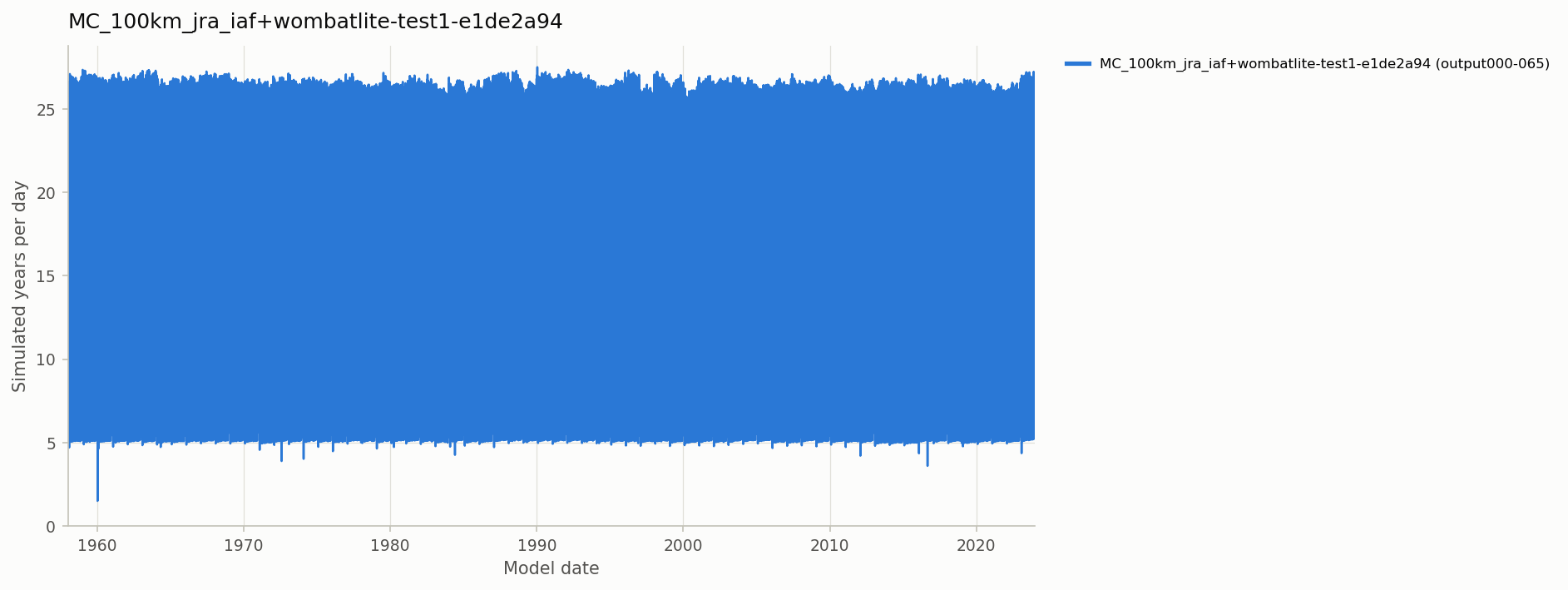
Check this on Gadi: the rate in each output's med.log
# WHAT THIS DOES: for each output folder, finds the model's speed in its med.log (the mediator's
# log) and averages it. The speed, called the 'rate', is in simulated years per day (ypd). The
# figure plots these rates. You get one line per output folder: how many rate lines it had, and
# their average.
A=/g/data/ol01/outputs/access-om3-100km/MC_100km_jra_iaf+wombatlite-test1-e1de2a94

for o in "$A"/output[0-9]*; do
    [ -f "$o/log/med.log" ] || continue            # skip folders that have no med.log
    # A line looks like: Model Date: 1958-09-04T00:00:00 ... rate = 7.09 ypd. awk reads the number just before
    # 'ypd' (the second-last word), adds them up and counts them, then prints the average at the end.
    awk -v name="$(basename "$o")" '/Model Date:/ && /ypd/ {count++; total += $(NF-1)} END {if (count) printf "%s: %d rate lines, mean %.2f ypd\n", name, count, total/count}' "$o/log/med.log"
done
Recent runs
From payu's job records in /g/data/ol01/outputs/access-om3-100km/MC_100km_jra_iaf+wombatlite-test1-e1de2a94/payu_jobs; times are Canberra time.
| Run | PBS job | Result | Model period | Wall time (h) | SYPD | Record last modified |
|---|---|---|---|---|---|---|
| 65 | 180395779.gadi-pbs | ✅ | 2023-01-01 → 2024-01-01 | 1.1 | 22.00 | 2026-10-03 21:06 AEST |
| 64 | 180364870.gadi-pbs | ✅ | 2022-01-01 → 2023-01-01 | 1.1 | 21.85 | 2026-10-03 09:49 AEST |
| 63 | 180362780.gadi-pbs | ✅ | 2021-01-01 → 2022-01-01 | 1.1 | 21.53 | 2026-10-03 08:33 AEST |
| 62 | 180361626.gadi-pbs | ✅ | 2020-01-01 → 2021-01-01 | 1.1 | 22.00 | 2026-10-03 07:18 AEST |
| 61 | 180360310.gadi-pbs | ✅ | 2019-01-01 → 2020-01-01 | 1.1 | 21.74 | 2026-10-03 06:05 AEST |
| 60 | 180358665.gadi-pbs | ✅ | 2018-01-01 → 2019-01-01 | 1.1 | 2026-10-03 04:47 AEST | |
| 59 | 180356325.gadi-pbs | ✅ | 2017-01-01 → 2018-01-01 | 1.1 | 22.10 | 2026-10-03 03:33 AEST |
| 58 | 180353427.gadi-pbs | ✅ | 2016-01-01 → 2017-01-01 | 1.1 | 21.65 | 2026-10-03 02:16 AEST |
| 57 | 180351342.gadi-pbs | ✅ | 2015-01-01 → 2016-01-01 | 1.1 | 21.75 | 2026-10-03 00:58 AEST |
| 56 | 180348038.gadi-pbs | ✅ | 2014-01-01 → 2015-01-01 | 1.1 | 21.92 | 2026-10-02 23:44 AEST |
Check this on Gadi: this table
# WHAT THIS DOES: prints the 'Recent runs' table: the 10 newest runs, newest first. 'ok' means
# payu's exit status was 0. SYPD is simulated years per day: the model time the run covered, divided
# by the wall-clock time it took. (If payu did not record a run's start date this shows ?; the page
# may fill it in from the previous run.)
A=/g/data/ol01/outputs/access-om3-100km/MC_100km_jra_iaf+wombatlite-test1-e1de2a94

python3 - "$A" <<'EOF'
import glob, json, os, sys

# payu keeps one small file for every run: payu_jobs/<number>/run/<job>.json. Read them all.
archive = sys.argv[1]                  # the archive folder, handed over by the shell line above
runs = []
for path in glob.glob(archive + "/payu_jobs/*/run/*.json"):
    try:
        with open(path) as f:
            record = json.load(f)
        record["file"] = path          # remember which file it came from
        runs.append(record)
    except (OSError, ValueError):
        pass                           # skip a file we may not read, or that is not valid JSON

# Put the runs in order: by run number, and by start time if a run was tried more than once.
runs.sort(key=lambda r: (int(r.get("payu_current_run") or 0), r.get("timings", {}).get("payu_start_time") or ""))

import time
from datetime import datetime

print("Run  PBS job             Result     Model period              Hours  SYPD   Record last modified")
for r in reversed(runs[-10:]):                     # the last 10 runs, newest first
    status = r.get("payu_run_status")
    result = "ok" if status == 0 else ("failed" if status is not None else str(r.get("stage")))
    start, finish = r.get("model_start_time"), r.get("model_finish_time")
    seconds = r.get("timings", {}).get("payu_total_duration_seconds")     # wall-clock seconds the run took
    hours = "%.1f" % (seconds / 3600) if seconds else ""
    sypd = ""
    if start and finish and seconds:
        # the model time the run covered, in whole days (dates look like 1958-01-01T00:00:00)
        days = (datetime.strptime(finish[:19], "%Y-%m-%dT%H:%M:%S") - datetime.strptime(start[:19], "%Y-%m-%dT%H:%M:%S")).days
        sypd = "%.2f" % (days / 365.25 / (seconds / 86400))     # model years divided by wall-clock days
    changed = time.strftime("%Y-%m-%d %H:%M %Z", time.localtime(os.path.getmtime(r["file"])))
    print("%-4s %-18s %-10s %-10s -> %-10s %6s %6s  %s" % (r.get("payu_current_run"), r.get("scheduler_job_id"), result,
          (start or "?")[:10], (finish or "?")[:10], hours, sypd, changed))
EOF
Latest logs in the archive folder
/g/data/ol01/outputs/access-om3-100km/MC_100km_jra_iaf+wombatlite-test1-e1de2a94/output065/access-om3.err (last lines; modified 2026-10-03 21:05 AEST)
 (t_initf) Read in prof_inparm namelist from: drv_in
 (t_initf) Using profile_disable=          F
 (t_initf)       profile_timer=                      4
 (t_initf)       profile_depth_limit=                4
 (t_initf)       profile_detail_limit=               2
 (t_initf)       profile_barrier=          F
 (t_initf)       profile_outpe_num=                  1
 (t_initf)       profile_outpe_stride=               0
 (t_initf)       profile_single_file=      F
 (t_initf)       profile_global_stats=     T
 (t_initf)       profile_ovhd_measurement= F
 (t_initf)       profile_add_detail=       F
 (t_initf)       profile_papi_enable=      F

WARNING from PE     0: set_diffusivity_init: SIMPLE_TKE_TO_KD can not be used reliably with USE_REGRIDDING.


WARNING from PE     0: diag_manager_mod::closing_file: module/output_field ocean_model/total_hfevapds, skip one time level, maybe send_data never called


WARNING from PE     0: diag_manager_mod::closing_file: module/output_field ocean_model/total_heat_content_massin, skip one time level, maybe send_data never called

                               Memuse(MB) at Memory HiWaterMark=  4.564E+02  8.491E+03  3.597E+02  4.906E+02
/g/data/ol01/outputs/access-om3-100km/MC_100km_jra_iaf+wombatlite-test1-e1de2a94/output065/access-om3.out (last lines; modified 2026-10-03 21:05 AEST)
(Ocean BT global synch)               8760     10.053530    177.997733     59.898857     30.737459  0.016    41     0   495
(Ocean Coriolis & mom advection)     17520      4.950229      8.866551      6.367064      0.726888  0.002    31     0   495
(Ocean continuity equation)          26280     38.369356     96.699875     68.947827     15.376553  0.018    31     0   495
(Ocean pressure force)                8760    103.328302    147.027789    128.814422     10.329897  0.034    31     0   495
(Ocean vertical viscosity)           43800     21.983983    120.536488     83.103422     29.514689  0.022    31     0   495
(Ocean horizontal viscosity)          8760     14.751858     37.314638     28.377657      5.676531  0.007    31     0   495
(Ocean momentum increments)          17520      2.635587      6.518128      4.548819      0.765894  0.001    31     0   495
(Ocean message passing)             122640     25.057144    267.962686    117.735520     51.894187  0.031    31     0   495
(Ocean barotropic mode calc)         17520      0.145385      0.301328      0.216602      0.027264  0.000    31     0   495
(Ocean barotropic mode stepping)     17520    131.730720    366.240797    197.562237     42.661338  0.052    31     0   495
(Ocean barotropic forcing calc)      17520      2.587689      6.590680      3.932876      0.690386  0.001    31     0   495
(Ocean kappa_shear)                   4380      8.540190    303.352370     98.481027     56.277480  0.026    31     0   495
(Ocean diabatic entrain)                 0      0.000000      0.000000      0.000000      0.000000  0.000    31     0   495
(Ocean vert remap)                    4380     14.537574     61.017440     40.989398     11.968789  0.011    31     0   495
(Ocean set_diffusivity)               8760     41.068896    340.083229    136.784461     57.834671  0.036    31     0   495
(Ocean KPP)                              0      0.000000      0.000000      0.000000      0.000000  0.000    31     0   495
(Ocean tracer_columns)                4380    898.525692   1328.048393   1158.203138     70.595923  0.305    26     0   495
(Ocean diabatic tridiag)              4380      0.828275      1.281302      0.968505      0.074917  0.000    41     0   495
(Ocean diabatic message passing)      8760      1.686879    443.777457    142.624226     95.651966  0.038    41     0   495
(Ocean differential diffusion)           0      0.000000      0.000000      0.000000      0.000000  0.000    41     0   495
(Ocean find_uv_at_h)                  8760      1.585654      4.679681      2.891291      0.836683  0.001    41     0   495
(Ocean frazil)                        8760      0.409560      2.302511      1.021465      0.382243  0.000    41     0   495
(Ocean advect tracer)                 4380    151.651224    181.179280    159.293084      4.909674  0.042    31     0   495
(Ocean tracer halo updates)          21909     56.569940    151.524822    114.130663     18.127296  0.030    41     0   495
(Ocean tracer global synch)          13149      2.860594    118.985279     42.355412     21.983045  0.011    41     0   495
(Ocean diffuse tracer)                4380     29.489048    263.341050    176.845642     71.854799  0.047    31     0   495
(Ocean epipycnal diffuse tracer)         0      0.000000      0.000000      0.000000      0.000000  0.000    31     0   495
Ocean surface forcing                17521     33.115755     89.929574     65.266536     11.168953  0.017    11     0   495
(Ocean forcing diagnostics)          13140     32.422083     34.429360     34.324256      0.087758  0.009    41     0   495
 MPP_STACK high water mark=           0
/g/data/ol01/outputs/access-om3-100km/MC_100km_jra_iaf+wombatlite-test1-e1de2a94/output065/log/med.log (last lines; modified 2026-10-03 21:05 AEST)
Model Date: 2023-12-20T00:00:00 wall clock = 2026-10-03T21:02:38 avg dt =    10.17 s/day, dt =     9.05 s/day, rate =    26.16 ypd
 memory_write: model date = 2023-12-20T00:00:00 memory =      -0.00 MB (highwater)        776.81 MB (usage)
Model Date: 2023-12-21T00:00:00 wall clock = 2026-10-03T21:02:47 avg dt =    10.17 s/day, dt =     9.13 s/day, rate =    25.94 ypd
 memory_write: model date = 2023-12-21T00:00:00 memory =      -0.00 MB (highwater)        776.81 MB (usage)
Model Date: 2023-12-22T00:00:00 wall clock = 2026-10-03T21:02:56 avg dt =    10.16 s/day, dt =     9.44 s/day, rate =    25.07 ypd
 memory_write: model date = 2023-12-22T00:00:00 memory =      -0.00 MB (highwater)        776.81 MB (usage)
Model Date: 2023-12-23T00:00:00 wall clock = 2026-10-03T21:03:05 avg dt =    10.16 s/day, dt =     8.90 s/day, rate =    26.58 ypd
 memory_write: model date = 2023-12-23T00:00:00 memory =      -0.00 MB (highwater)        776.81 MB (usage)
Model Date: 2023-12-24T00:00:00 wall clock = 2026-10-03T21:03:14 avg dt =    10.16 s/day, dt =     9.00 s/day, rate =    26.29 ypd
 memory_write: model date = 2023-12-24T00:00:00 memory =      -0.00 MB (highwater)        776.81 MB (usage)
Model Date: 2023-12-25T00:00:00 wall clock = 2026-10-03T21:03:23 avg dt =    10.15 s/day, dt =     8.91 s/day, rate =    26.57 ypd
 memory_write: model date = 2023-12-25T00:00:00 memory =      -0.00 MB (highwater)        776.81 MB (usage)
Model Date: 2023-12-26T00:00:00 wall clock = 2026-10-03T21:03:32 avg dt =    10.15 s/day, dt =     8.99 s/day, rate =    26.34 ypd
 memory_write: model date = 2023-12-26T00:00:00 memory =      -0.00 MB (highwater)        776.81 MB (usage)
Model Date: 2023-12-27T00:00:00 wall clock = 2026-10-03T21:03:41 avg dt =    10.15 s/day, dt =     9.03 s/day, rate =    26.22 ypd
 memory_write: model date = 2023-12-27T00:00:00 memory =      -0.00 MB (highwater)        776.81 MB (usage)
Model Date: 2023-12-28T00:00:00 wall clock = 2026-10-03T21:03:50 avg dt =    10.14 s/day, dt =     8.81 s/day, rate =    26.88 ypd
 memory_write: model date = 2023-12-28T00:00:00 memory =      -0.00 MB (highwater)        776.81 MB (usage)
Model Date: 2023-12-29T00:00:00 wall clock = 2026-10-03T21:03:59 avg dt =    10.14 s/day, dt =     8.88 s/day, rate =    26.66 ypd
 memory_write: model date = 2023-12-29T00:00:00 memory =      -0.00 MB (highwater)        776.81 MB (usage)
Model Date: 2023-12-30T00:00:00 wall clock = 2026-10-03T21:04:08 avg dt =    10.14 s/day, dt =     8.98 s/day, rate =    26.36 ypd
 memory_write: model date = 2023-12-30T00:00:00 memory =      -0.00 MB (highwater)        776.81 MB (usage)
Model Date: 2023-12-31T00:00:00 wall clock = 2026-10-03T21:04:17 avg dt =    10.13 s/day, dt =     9.02 s/day, rate =    26.23 ypd
 memory_write: model date = 2023-12-31T00:00:00 memory =      -0.00 MB (highwater)        776.81 MB (usage)
 -------->(med_phases_restart_write) mediating for: 2023 12 31 23  0  0   0
(med_io_wopen) creating file access-om3.cpl.r.2024-01-01-00000.nc
Model Date: 2024-01-01T00:00:00 wall clock = 2026-10-03T21:05:02 avg dt =    10.23 s/day, dt =    45.28 s/day, rate =     5.23 ypd
 memory_write: model date = 2024-01-01T00:00:00 memory =      -0.00 MB (highwater)        776.81 MB (usage)
  SUCCESSFUL TERMINATION OF CMEPS
: ===============  # simulated years / cmp-day =       23.140  ===============
Check this on Gadi: when these logs were written, and their last lines
# WHAT THIS DOES: for each log file listed above, prints when it was last changed and its last 30
# lines, which are the lines the page shows.

# 'for' repeats the three lines below once for each file; $f is the file it is on.
# 'ls -l' lists a file with details; --time-style=long-iso writes its time as 2026-07-01 00:02.
for f in /g/data/ol01/outputs/access-om3-100km/MC_100km_jra_iaf+wombatlite-test1-e1de2a94/output065/access-om3.err /g/data/ol01/outputs/access-om3-100km/MC_100km_jra_iaf+wombatlite-test1-e1de2a94/output065/access-om3.out /g/data/ol01/outputs/access-om3-100km/MC_100km_jra_iaf+wombatlite-test1-e1de2a94/output065/log/med.log; do
    echo "== $f"                          # which file this is
    ls -l --time-style=long-iso "$f"      # when it was last changed (the date and time are in the middle)
    tail -n 30 "$f"                       # its last 30 lines
done
/g/data/ol01/outputs/access-om3-100km/MC_100km_jra_iaf+wombatlite-test1-e1de2a94/metadata.yaml
# ---- Automatically generated by Payu. Do not edit. ----
experiment_uuid: e1de2a94-f745-4192-b7c3-5c7606daf4ff

# ---- Automatically generated by Payu. User may edit if necessary. ----
name: MC_100km_jra_iaf+wombatlite-test1-e1de2a94
contact: minghangli-uni
email: 24727729+minghangli-uni@users.noreply.github.com
created: '2026-09-28'
url: https://github.com/ACCESS-NRI/access-om3-configs.git
model: ACCESS-OM3
Truncation locations for all completed run segments
⚠️ MOM6 truncated velocities 1,216 times in 2 of 66 output folders (the Truncs column of each outputNNN/ocean.stats). MOM6 truncates a velocity when its CFL number exceeds CFL_TRUNCATE (0.5 by default), and stops the run if more than MAXTRUNC truncations happen between energy saves (MOM6's default is 0, so any truncation stops it; the ACCESS-OM3 configurations set 10,000). See MOM6 velocity truncations for how to read the records, and Examine_truncation_data.ipynb for mapping them.
Location records are the detailed records MOM6 also writes, one per truncation, to U_velocity_truncations (zonal velocity) and V_velocity_truncations (meridional velocity); the location table below is built from them. MOM6 writes at most 50 per PE per run, so there are usually fewer of them than truncations; – means no file of that kind.
| Output folder | Model period | Truncations | Max CFL | Location records (U / V) | PEs at the record cap |
|---|---|---|---|---|---|
| output036 | 1994-01 → 1995-01 | 6 | 0.18 | 6 / – | – |
| output042 | 2000-01 → 2001-01 | 1,210 | 0.49 | 159 / 17 | – |
The other 64 output folders had no truncations.
Where MOM6 truncates (1° boxes, most records first; from the U_velocity_truncations and V_velocity_truncations files):
| Location | Records | Grid cells | Seen in output | Velocity | Layers | Max speed (m/s) | Max CFL | Surface height (m) | Depth (m) |
|---|---|---|---|---|---|---|---|---|---|
| 108.9°W, 72.9°N | 24 | 2 | 042 | U | 1–12 | 13.8 | 1.42 | 5.90 | 118 |
| 108.1°W, 72.4°N | 24 | 2 | 042 | U | 1–9 | 13.5 | 1.38 | 12.62 | 47 |
| 96.9°W, 75.9°N | 17 | 3 | 036, 042 | U | 1–11 | 15.9 | 1.81 | -1.07 | 55 |
| 62.4°W, 82.0°N | 10 | 1 | 042 | U | 1–2 | 6.6 | 0.70 | -1.59 | 499 |
| 97.1°W, 75.3°N | 9 | 2 | 036, 042 | U | 1–11 | 13.4 | 1.50 | -0.93 | 103 |
| 61.2°W, 82.2°N | 9 | 1 | 042 | U | 1–2 | 5.1 | 0.68 | 2.56 | 272 |
| 63.8°W, 81.2°N | 8 | 1 | 042 | U | 1–3 | 5.8 | 0.76 | -1.46 | 329 |
| 101.0°W, 69.5°N | 7 | 2 | 042 | V | 1–3 | 2.9 | 0.64 | -1.35 | 17 |
| 65.9°W, 80.8°N | 6 | 1 | 042 | U | 1–2 | 5.9 | 0.77 | -1.04 | 272 |
| 64.8°W, 81.0°N | 5 | 1 | 042 | U | 1–2 | 5.8 | 0.76 | -1.36 | 300 |
| 66.9°W, 80.6°N | 5 | 1 | 042 | U | 1–2 | 5.5 | 0.71 | -0.73 | 272 |
| 22.2°W, 82.0°N | 4 | 1 | 042 | U | 1–5 | 6.3 | 1.63 | -1.05 | 48 |
| 67.9°W, 80.4°N | 4 | 1 | 042 | U | 1–1 | 4.7 | 0.61 | -0.96 | 271 |
| 104.4°W, 75.8°N | 4 | 2 | 042 | U | 1–6 | 9.2 | 1.04 | -1.70 | 106 |
| 23.9°W, 81.9°N | 3 | 1 | 042 | U | 1–4 | 6.1 | 0.81 | -2.05 | 48 |
| 96.6°W, 76.5°N | 3 | 1 | 042 | U | 1–3 | 25.1 | 2.88 | -0.48 | 137 |
| 97.8°W, 76.9°N | 3 | 2 | 042 | U | 1–2 | 5.5 | 0.65 | -0.51 | 161 |
| 104.7°W, 76.3°N | 3 | 2 | 042 | U | 1–7 | 8.6 | 0.99 | -1.14 | 121 |
| 89.6°W, 76.0°N | 3 | 1 | 042 | V | 1–8 | 9.6 | 0.99 | 9.98 | 23 |
| 38.6°W, 83.7°N | 2 | 1 | 042 | U | 1–1 | 4.5 | 0.62 | -0.58 | 122 |
* MOM6 writes at most 50 records per PE per run (MAX_TRUNC_FILE_SIZE_PER_PE), and this box's PE hit that cap in at least one run, so it truncated more often than the record count shows. Surface height is the top-interface height e, shown only for records that include layer 1; depth is the shallower of the two cells (D).
Check this on Gadi: the truncation counts, locations and settings
# WHAT THIS DOES: re-checks the 'Truncation locations' section from the files MOM6 wrote. A
# truncation is when MOM6 had to cut a velocity that was too fast (its CFL number was above 0.5): a
# sign of numerical trouble. The steps below are separate, so you can paste just the one you need.
# Each prints something you can compare with the page.
A=/g/data/ol01/outputs/access-om3-100km/MC_100km_jra_iaf+wombatlite-test1-e1de2a94

# Step 1: for each output folder: how many truncations MOM6 reported, the largest CFL number, and how many location records were written
for o in "$A"/output[0-9]*; do
    # ocean.stats is a table with one line per time step. Its 3rd column ('Truncs') is the truncations at that
    # step. awk adds that column up. (-F, means the columns are separated by commas. The header line is skipped
    # because its first column is not a number.)
    total=$(awk -F, '$1+0 == $1 {sum += $3} END {print sum+0}' "$o/ocean.stats" 2>/dev/null)
    # The 5th column holds two numbers; the second one is the CFL number. awk keeps the largest.
    cfl=$(awk -F, '$1+0 == $1 {split($5, a, " "); if (a[2] > max) max = a[2]} END {if (max != "") printf "%.2f", max}' "$o/ocean.stats" 2>/dev/null)
    # Every truncation also gets a 'location record' in the U and V files. grep -c counts the matching lines.
    u=$(grep -c 'velocity violation' "$o/U_velocity_truncations" 2>/dev/null)
    v=$(grep -c 'velocity violation' "$o/V_velocity_truncations" 2>/dev/null)
    # ${x:--} means: use x, or a dash if x is empty (no such file)
    echo "$(basename "$o"): truncations ${total:--}, max CFL ${cfl:--}, location records U/V ${u:--}/${v:--}"
done

# Step 2: where it happens. Each record contains the place, like '( 73.27 E 67.89 N)'. This counts the records in
# boxes one degree wide (negative longitude means west), busiest first. The pipeline does this:
#   grep: keep the lines that start a record    sed: keep only the longitude and latitude
#   awk: round them to whole degrees            sort | uniq -c: count the records in each box
#   sort -rn | head: busiest boxes first
grep -h 'velocity violation' "$A"/output[0-9]*/[UV]_velocity_truncations 2>/dev/null \
  | sed -E 's/.*\( *(-?[0-9.]+) E +(-?[0-9.]+) N\).*/\1 \2/' \
  | awk '{printf "%4.0fE %4.0fN\n", $1, $2}' \
  | sort | uniq -c | sort -rn | head -n 15

# Step 3: MOM6 writes at most 50 records per PE (one of the parallel processes) in one run, then stops. A PE with
# 50 records may have truncated more often than the records show. This lists the PEs that reached 50.
for f in "$A"/output[0-9]*/[UV]_velocity_truncations; do
    [ -f "$f" ] || continue                 # skip if there is no such file
    # each record says which PE it came from ('violation at 6073:'); count the records per PE, keep PEs with 50
    busy=$(grep -h 'velocity violation' "$f" | sed -E 's/.*violation at ([0-9]+):.*/PE\1/' | sort | uniq -c | awk '$1 >= 50 {printf "%s (%d records) ", $2, $1}')
    echo "$(basename "$(dirname "$f")")/$(basename "$f"): $busy"
done

# Step 4: one record in full. The page reads the speed (u, v), the CFL number, the surface height (e) and the
# depth (D) from lines like these.
head -n 30 "$A"/output036/U_velocity_truncations

# Step 5: the model period of each output folder, from payu's run records (output NNN is run NNN)
python3 - "$A" <<'EOF'
import glob, json, os, sys

# payu keeps one small file for every run: payu_jobs/<number>/run/<job>.json. Read them all.
archive = sys.argv[1]                  # the archive folder, handed over by the shell line above
runs = []
for path in glob.glob(archive + "/payu_jobs/*/run/*.json"):
    try:
        with open(path) as f:
            record = json.load(f)
        record["file"] = path          # remember which file it came from
        runs.append(record)
    except (OSError, ValueError):
        pass                           # skip a file we may not read, or that is not valid JSON

# Put the runs in order: by run number, and by start time if a run was tried more than once.
runs.sort(key=lambda r: (int(r.get("payu_current_run") or 0), r.get("timings", {}).get("payu_start_time") or ""))

for r in runs:
    run, finish = r.get("payu_current_run"), r.get("model_finish_time")
    if str(run).isdigit() and finish:      # only runs that finished have a model period
        start = r.get("model_start_time") or "?"      # payu did not record the start of the first run
        print("output%03d  %s -> %s" % (int(run), start[:7], finish[:7]))
EOF
Settings changed during this run
This comes from the git history of the payu control directory, and this experiment has no run_dir in experiments.yml. Add one to see here every edit made to the model's settings and build during the run, with the old and new values.